
Choosing the right shipping container starts with understanding its dimensions. Container size affects how much cargo, equipment, inventory, or storage material can fit inside, how the container can be transported, and how effectively it can be used at your location.
At Worldwide Container Supply, we provide container solutions in different sizes and configurations to meet a wide range of storage, transportation, construction, commercial, and industrial requirements. Understanding the difference between 10ft, 20ft, 40ft Standard Dry, and 40ft High Cube containers can help you select the option that best matches your project.
Understanding Shipping Container Dimensions
Shipping container dimensions are generally described using three measurements: length, width, and height.
The length determines how much space is available from the front to the rear of the container. The width determines the side-to-side space, while the height determines the vertical clearance available inside.
There are also several other measurements worth considering, including interior dimensions, door opening, exterior floor area, interior cubic capacity, and container weight.
These measurements provide a more complete picture of how a container can be used.
See exact shipping container dimensions below:
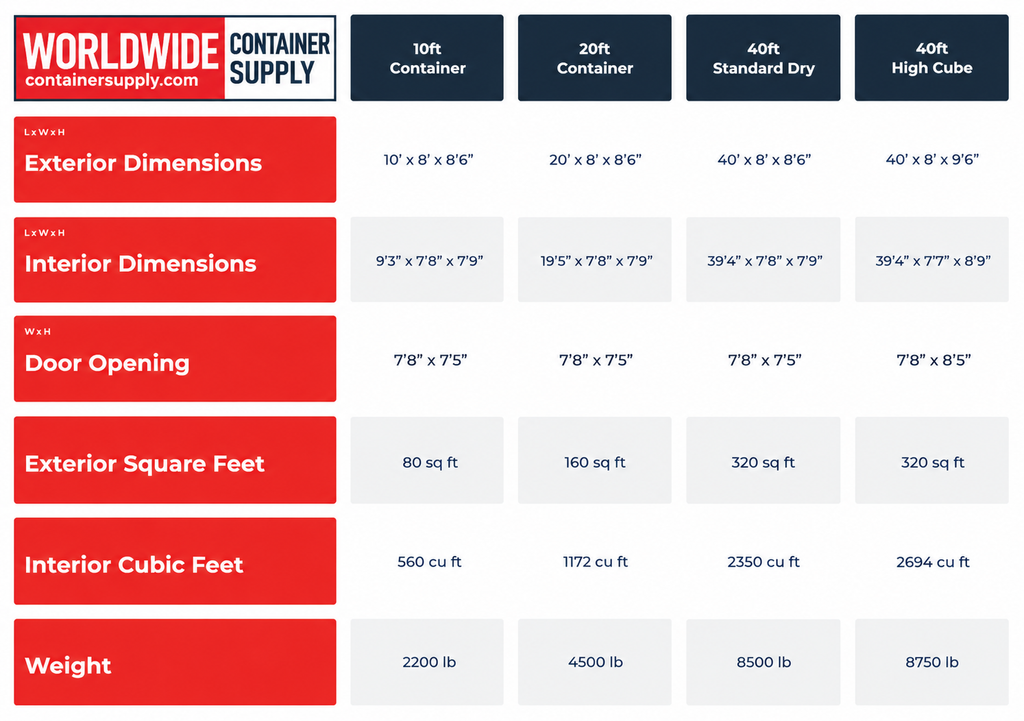
Last updated: November 2025
These measurements can help customers compare container sizes before making a purchasing or sourcing decision.
10ft Container Dimensions
The 10ft container is the most compact option in the specifications provided. With exterior dimensions of 10′ × 8′ × 8’6″, it provides a practical solution for customers who need storage capacity but have limited available space.
Its interior dimensions are 9’3″ × 7’8″ × 7’9″, providing approximately 560 cubic feet of interior capacity.
The exterior floor area is approximately 80 square feet, making this size suitable for locations where a larger container may not be practical.
The door opening measures 7’8″ × 7’5″, providing access for loading and unloading goods, equipment, tools, and other materials.
The listed container weight is 2,200 lb.
10ft Container Specifications
| Feature | Measurement |
|---|---|
| Exterior Dimensions | 10′ × 8′ × 8’6″ |
| Interior Dimensions | 9’3″ × 7’8″ × 7’9″ |
| Door Opening | 7’8″ × 7’5″ |
| Exterior Area | 80 sq ft |
| Interior Capacity | 560 cu ft |
| Weight | 2,200 lb |
A 10ft container can be particularly useful when space is limited or when the customer does not require the capacity of a larger container.
20ft Container Dimensions
The 20ft container provides twice the exterior floor area of the 10ft container. Its exterior dimensions are 20′ × 8′ × 8’6″, while its interior dimensions measure 19’5″ × 7’8″ × 7’9″.
The container provides approximately 160 square feet of exterior floor area and 1,172 cubic feet of interior capacity.
The door opening is 7’8″ × 7’5″, providing practical access for loading and unloading.
The listed weight is 4,500 lb.
20ft Container Specifications
| Feature | Measurement |
|---|---|
| Exterior Dimensions | 20′ × 8′ × 8’6″ |
| Interior Dimensions | 19’5″ × 7’8″ × 7’9″ |
| Door Opening | 7’8″ × 7’5″ |
| Exterior Area | 160 sq ft |
| Interior Capacity | 1,172 cu ft |
| Weight | 4,500 lb |
A 20ft container is a versatile option for customers who need more capacity than a 10ft unit while maintaining a manageable footprint.
It can be used for general storage, commercial inventory, construction materials, equipment, agricultural supplies, and transportation applications.
40ft Standard Dry Container Dimensions
The 40ft Standard Dry container provides substantially more space than the 10ft and 20ft options.
Its exterior dimensions are 40′ × 8′ × 8’6″. The interior dimensions are 39’4″ × 7’8″ × 7’9″.
The container provides approximately 320 square feet of exterior floor area and 2,350 cubic feet of interior capacity.
The door opening measures 7’8″ × 7’5″, allowing access for loading and unloading a wide range of cargo and storage materials.
The listed weight is 8,500 lb.
40ft Standard Dry Specifications
| Feature | Measurement |
|---|---|
| Exterior Dimensions | 40′ × 8′ × 8’6″ |
| Interior Dimensions | 39’4″ × 7’8″ × 7’9″ |
| Door Opening | 7’8″ × 7’5″ |
| Exterior Area | 320 sq ft |
| Interior Capacity | 2,350 cu ft |
| Weight | 8,500 lb |
The 40ft Standard Dry container can be a practical choice for customers who need substantial storage or cargo capacity while maintaining the standard container height.
40ft High Cube Container Dimensions
The 40ft High Cube container has the same listed exterior length and width as the 40ft Standard Dry container but provides additional height.
Its exterior dimensions are 40′ × 8′ × 9’6″, making it one foot taller externally than the standard 40ft container.
The interior dimensions are 39’4″ × 7’7″ × 8’9″, providing approximately 2,694 cubic feet of interior capacity.
The door opening measures 7’8″ × 8’5″, providing additional vertical access compared with the other container options listed.
The listed weight is 8,750 lb.
40ft High Cube Specifications
| Feature | Measurement |
|---|---|
| Exterior Dimensions | 40′ × 8′ × 9’6″ |
| Interior Dimensions | 39’4″ × 7’7″ × 8’9″ |
| Door Opening | 7’8″ × 8’5″ |
| Exterior Area | 320 sq ft |
| Interior Capacity | 2,694 cu ft |
| Weight | 8,750 lb |
The additional height gives the 40ft High Cube approximately 344 more cubic feet of interior capacity than the listed 40ft Standard Dry container.
This additional vertical space can be useful when the project involves goods or materials that benefit from increased internal clearance.
Comparing 10ft, 20ft, and 40ft Containers
Container size should be selected according to the amount of space required, the available placement area, and the intended use.
| Container | Floor Area | Interior Capacity | Listed Weight |
|---|---|---|---|
| 10ft | 80 sq ft | 560 cu ft | 2,200 lb |
| 20ft | 160 sq ft | 1,172 cu ft | 4,500 lb |
| 40ft Standard Dry | 320 sq ft | 2,350 cu ft | 8,500 lb |
| 40ft High Cube | 320 sq ft | 2,694 cu ft | 8,750 lb |
The 10ft container is the smallest option in the specifications provided. The 20ft container provides substantially more floor and storage capacity, while the 40ft Standard Dry provides twice the listed floor area of the 20ft option.
The 40ft High Cube maintains the same listed exterior floor area as the 40ft Standard Dry but provides greater interior cubic capacity because of its additional height.
Why Interior Dimensions Matter
Exterior dimensions tell you how much physical space the container occupies, but interior dimensions tell you how much usable space is available for your goods.
For example, a container may have an exterior length of 40 feet, but its usable interior length is shorter because of the container’s structural walls and other components.
For this reason, customers should always consider the interior dimensions when determining whether a container can accommodate particular equipment, materials, inventory, or other items.
If you are storing large objects, measure them before selecting a container.
Understanding Door Opening Dimensions
Door opening dimensions are particularly important when loading large or bulky items.
The door opening determines the maximum opening available for moving goods into and out of the container.
The listed specifications show that the 10ft, 20ft, and 40ft Standard Dry containers have a door opening of 7’8″ × 7’5″, while the 40ft High Cube has a larger listed door opening of 7’8″ × 8’5″.
Customers should consider both the dimensions of the cargo and the equipment being used to load it.
Understanding Exterior Square Feet
Exterior square footage provides an indication of the footprint a container occupies.
According to the provided specifications, the 10ft container has 80 square feet, the 20ft container has 160 square feet, and both 40ft options have 320 square feet.
This measurement can be particularly important when planning a storage yard, construction site, commercial property, agricultural area, or other location where containers will be positioned.
Before delivery, customers should ensure that there is adequate space for the container and the equipment required to position it.
Understanding Interior Cubic Feet
Interior cubic feet provides an indication of the total enclosed volume inside the container.
The listed capacities are:
- 10ft: 560 cubic feet
- 20ft: 1,172 cubic feet
- 40ft Standard Dry: 2,350 cubic feet
- 40ft High Cube: 2,694 cubic feet
Cubic capacity is particularly useful when the objective is to maximize the amount of material that can be stored inside a container.
However, customers should remember that usable capacity can depend on the shape and dimensions of the items being stored.
Container Weight
The weight of a container is another important consideration.
According to the provided specifications, the 10ft container weighs 2,200 lb, the 20ft container weighs 4,500 lb, the 40ft Standard Dry container weighs 8,500 lb, and the 40ft High Cube weighs 8,750 lb.
Container weight matters when planning transportation, delivery, lifting, positioning, and site preparation.
Customers should ensure that the transportation and handling equipment being used is appropriate for the selected container and its loaded contents.
Choosing the Right Container Size
The best container size depends on what you intend to store or transport.
A 10ft container may be appropriate when a smaller footprint is preferred and the required storage capacity is relatively limited.
A 20ft container can provide a balance between available space and storage capacity, making it a versatile choice for many applications.
A 40ft Standard Dry container provides substantially more floor space and cubic capacity for larger storage and cargo requirements.
A 40ft High Cube container may be preferred when additional vertical space is valuable and the project requires greater interior cubic capacity.
Container Dimensions for Storage
Storage is one of the most common applications for shipping containers.
Businesses may use containers to store inventory, tools, machinery, spare parts, construction materials, agricultural supplies, and other goods.
Individuals may also use containers for household storage, equipment, seasonal items, or property-related projects.
When choosing a storage container, consider the quantity and dimensions of the items you intend to store rather than selecting a container based only on its external appearance.
Container Dimensions for Construction
Construction sites often require secure storage for tools, materials, equipment, and supplies.
A 10ft or 20ft container may be suitable for smaller projects, while larger construction operations may benefit from the additional capacity of a 40ft container.
The available site area should also be considered. A larger container provides more storage but requires more room for placement and access.
Container Dimensions for Commercial Use
Businesses often require additional storage space as inventory levels grow.
A 20ft or 40ft container can provide additional capacity without requiring the construction of a permanent storage structure.
For businesses handling larger volumes of inventory, the additional cubic capacity of a 40ft High Cube container may be useful.
The right choice ultimately depends on the volume, dimensions, and type of products being stored.
Container Dimensions and Site Planning
Before ordering a container, customers should measure the location where the container will be placed.
Consider the container’s:
Length
The site must have sufficient length to accommodate the container.
Width
Allow enough space for the container itself and appropriate access around it.
Height
Check for overhead restrictions such as buildings, power lines, trees, gates, and other structures.
Access
There must be enough room for the delivery equipment to reach and position the container.
Ground Conditions
The placement area should be suitable for supporting the container safely.
Planning these factors before delivery can help reduce installation and positioning problems.
Container Dimensions and Delivery
Container delivery involves more than simply transporting a unit to a destination.
The delivery vehicle and unloading equipment must have enough space to approach the intended location. Customers should therefore communicate any site restrictions before delivery.
Narrow roads, low bridges, gates, overhead wires, steep driveways, and restricted access areas can affect delivery planning.
Providing accurate delivery information allows the appropriate arrangements to be considered before the container is dispatched.
Standard Dry vs High Cube
The key dimensional difference between the 40ft Standard Dry and 40ft High Cube options is height.
Both have listed exterior dimensions of 40′ × 8′ in length and width, but the Standard Dry is 8’6″ high, while the High Cube is 9’6″ high.
The additional height gives the High Cube a listed interior capacity of 2,694 cubic feet, compared with 2,350 cubic feet for the 40ft Standard Dry.
| Feature | 40ft Standard Dry | 40ft High Cube |
|---|---|---|
| Exterior Length | 40′ | 40′ |
| Exterior Width | 8′ | 8′ |
| Exterior Height | 8’6″ | 9’6″ |
| Interior Length | 39’4″ | 39’4″ |
| Interior Width | 7’8″ | 7’7″ |
| Interior Height | 7’9″ | 8’9″ |
| Door Opening | 7’8″ × 7’5″ | 7’8″ × 8’5″ |
| Exterior Area | 320 sq ft | 320 sq ft |
| Interior Capacity | 2,350 cu ft | 2,694 cu ft |
| Listed Weight | 8,500 lb | 8,750 lb |
The High Cube can therefore be particularly useful when additional vertical storage space is important.
Find the Right Container for Your Project
Understanding container dimensions is an essential step before purchasing or sourcing a shipping container.
The 10ft, 20ft, 40ft Standard Dry, and 40ft High Cube containers each offer different levels of floor area, interior capacity, height, access, and overall footprint.
Before making your selection, consider what you need to store or transport, how much space is available at your location, how the container will be delivered, and whether additional interior capacity or height is important for your project.
At Worldwide Container Supply, we can help customers explore container options based on their storage, commercial, construction, transportation, agricultural, and specialized requirements.
Whether you need a compact 10ft container, versatile 20ft container, spacious 40ft Standard Dry, or higher-capacity 40ft High Cube, understanding the dimensions first can help you make a more informed decision.
Worldwide Container Supply — practical container solutions for storage, transportation, business, and projects worldwide.
